
⚖️ NYS & NYC Law · Article 32 · Local Law 55
NYC & New York State Mold Law – Explained Plainly
New York has some of the strictest mold rules in the country. This page explains Article 32, Local Law 55, HPD violations, and what they mean for tenants and landlords in Inwood.
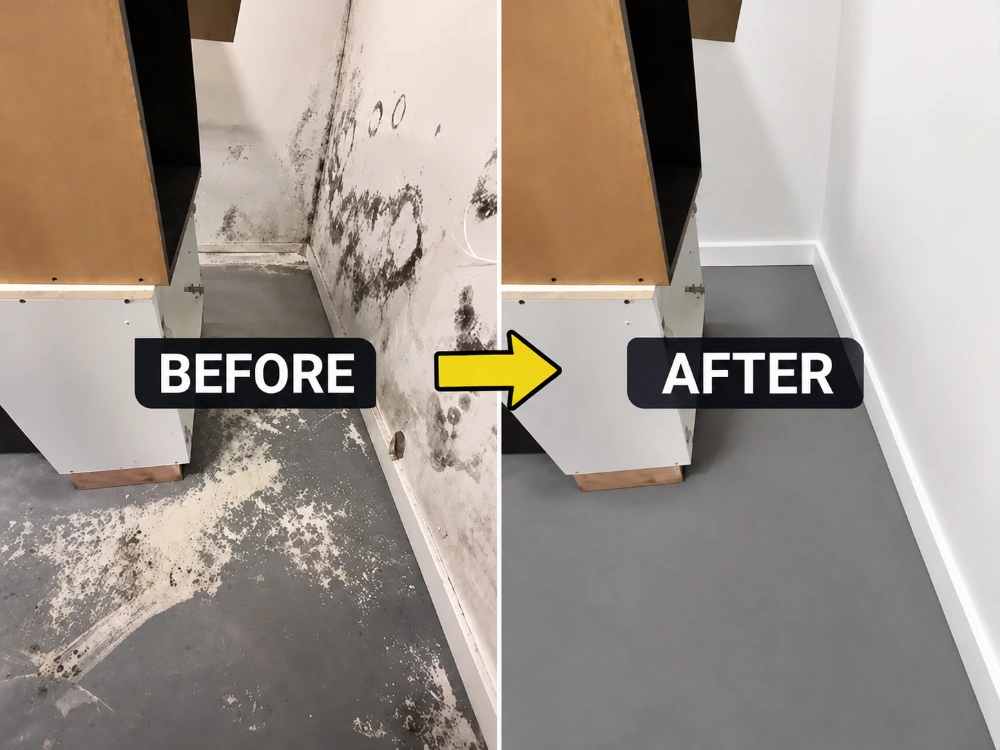
Before and after – Article 32 licensed remediation. 61 Seaman Ave area, Inwood.
What New York State Mold Law Actually Requires – and Why It Was Created
New York State has the strictest mold remediation laws in the country – enacted specifically because of post-Sandy fraud. This page explains every law that applies to mold in Inwood buildings, in plain language, sourced directly from the statutes and agencies that enforce them.
I’ve been doing mold work in these pre-war walk-ups long enough to know that most people – tenants, landlords, even some contractors – don’t actually understand what the law requires. They know the word “Article 32.” They don’t know what it means for them specifically. This page fixes that.
Every building on Seaman Ave, Post Ave, Payson Ave, Broadway, Dyckman Street – the entire 10034 ZIP – falls under the same regulatory framework. Know it before you call anyone. The mold removal service in Inwood we run is built around these rules – licensed assessment, independent remediation, third-party clearance.
The Most Important Law You’ve Never Heard Of: NYS Article 32
In January 2016, New York State enacted Labor Law Article 32 – the Mold Damage Prevention Law. It was a direct response to the wave of fraudulent remediation companies that hit Upper Manhattan and the rest of the city after Superstorm Sandy. Companies were showing up, scaring homeowners with inflated mold claims, doing sloppy work, then charging thousands for a “clearance” they wrote themselves.
Article 32 was designed to break that model. Here’s what it actually requires:
The Core Rule: Assessor and Remediator Must Be Separate
For any mold project covering more than 10 square feet, New York State requires that the company assessing the mold and the company removing it be two independent, separately licensed businesses. The same company legally cannot do both on the same job.
Why? Because when one company diagnoses and treats, they profit from inflating the diagnosis. The separation removes that financial incentive entirely. The assessor has no money to make from scaring you into a bigger job.
- The licensed mold assessor inspects, identifies extent, tests if needed, and writes the remediation plan – before any work starts
- The licensed mold remediation contractor performs the removal per that written plan
- A separate assessor – not the contractor, not the original assessor’s colleague – performs the final post-remediation clearance test
- All three roles require individual NYS licenses, verifiable at dol.ny.gov
No – not for any project over 10 square feet. Under NYS Article 32, the licensed assessor and the licensed remediator must be two separate, independent companies. Any company offering “we test and remove” as a single bundled service is either not being precise about how they separate the roles, or offering something that isn’t permitted under the law at that scale. Verify any license free at dol.ny.gov.
What the 10 Square Foot Threshold Actually Means
Ten square feet is roughly the size of a standard bath towel laid flat. It sounds small. In practice, most real mold problems in pre-war Inwood buildings – a basement wall, a bathroom where grout has been wet for months, wall cavities adjacent to a leaking supply riser – exceed this threshold before the owner even realizes there’s a problem.
Below 10 square feet, routine cleaning under proper precautions is permissible without a licensed mold assessor. Above it, the licensed assessor must produce a written remediation plan before any work begins. That plan documents the affected areas, materials, quantities, methods, moisture findings, and estimated cost and time. No plan, no work – that’s the sequence the law requires.
Under Article 32, a licensed NYS mold assessor must produce a written remediation plan before any remediation work begins on a project over 10 sq ft. The plan must document: which rooms or areas are affected, what materials are involved, quantities, methods to be used, cost and time estimates, and the identified moisture source. This document is yours – keep it, because it’s part of the clearance record.
The Three License Types and What Each Covers
| License Type | Who Holds It | What They Do |
|---|---|---|
| Mold Assessor | Individual – not a company credential | Inspects, tests, documents extent, writes the remediation plan, performs clearance testing after work is complete |
| Mold Remediation Contractor | Company license + individual workers | Performs containment, physical removal, HEPA cleaning, antimicrobial treatment, drying – per the assessor’s plan |
| Mold Abatement Worker | Individual worker credential | Works under the remediation contractor; company license alone doesn’t cover unlicensed workers on the job |
This distinction matters. A company can hold a Mold Remediation Contractor license, but every individual doing physical mold work on your job needs to hold a Mold Abatement Worker credential. Ask to see both when you hire anyone. If they can’t produce both, they’re not in compliance.
NYC Local Law 55 of 2018 – The Asthma-Free Housing Act
On top of state law, New York City added its own layer in 2018. Local Law 55 – formally called the Asthma-Free Housing Act – goes further than Article 32 by making mold inspection a proactive landlord obligation, not just a reactive one.
This law was written specifically for the reality of NYC rental buildings. Inwood is almost entirely covered by it: virtually every building on the block is a multi-unit rental, which means virtually every building falls under LL55 requirements.
Annual Proactive Inspection – Required, Not Optional
In buildings with 3 or more residential units, landlords must proactively inspect every unit for mold and pest hazards at least once per year. They don’t wait for complaints. They don’t wait for visible problems. They inspect.
The law also applies to buildings where any tenant has been diagnosed with moderate-to-severe asthma – which is a significant share of Inwood households given the neighborhood’s air quality challenges.
- Mold of 10+ square feet in a 10+ unit building triggers the full Article 32 licensed-assessor/remediator requirement
- HPD can issue Class B (hazardous) or Class C (immediately hazardous) violations for mold found on inspection
- Fines for non-compliance can reach $10,000
- Landlords must give tenants the DOHMH Indoor Allergens fact sheet at lease signing and renewal
HPD Violation Classes for Mold – What Each One Means
Class B – Hazardous
Issued for mold that is hazardous but not immediately life-threatening. Landlord has approximately 30 days to correct and file a Certification of Correction with HPD. If they don’t, daily penalties begin accruing.
Class C – Immediately Hazardous
Issued for 30 or more square feet of mold in a room. Cure window is 21 days. Highest fine exposure. Most likely to trigger Housing Court action.
No. HPD code inspectors issue violations based on visible mold only – they do not test for species, mycotoxin levels, or how far the mold extends behind walls or into materials. If you need to know the type of mold and actual extent of contamination, that requires an independent licensed mold assessor running air samples and surface scrapings sent to an AIHA-accredited laboratory. That is a separate, paid service – not something the city provides.
The IICRC S520 Standard – The Technical Benchmark Behind the Law
Article 32 and Local Law 55 are the legal requirements. The ANSI/IICRC S520 Standard for Professional Mold Remediation (2024 Fourth Edition) is the technical protocol that licensed contractors follow to meet those legal requirements.
S520 covers the procedures and precautions for mold remediation in residential, commercial, and institutional buildings. It’s the industry’s documented standard for containment protocols, HEPA filtration requirements, negative air pressure during work, post-remediation verification procedures, and the conditions under which a clearance test passes. When a contractor tells you their work complies with S520, they’re telling you they’re following a documented, peer-reviewed technical protocol – not just winging it.
Any licensed mold remediation contractor in New York should be able to tell you they follow the ANSI/IICRC S520 standard. If they can’t or won’t, that’s a flag.
The Tenant Complaint Pathway – Step by Step
If you rent in Inwood and have mold that your landlord won’t address, this is the exact legal process. I’ve helped enough tenants in these buildings navigate it that I can walk you through it clearly.
Document Everything First
Photograph and video the mold – date-stamped – and keep records of any respiratory symptoms, especially in children. “Your observation of the mold doesn’t mean very much in court” is real attorney advice from mold litigation cases. Documentation is what moves cases.
Written Notice to Your Landlord
Send a dated written notice describing the mold, requesting repair within a reasonable time. A letter mailed with proof of delivery is stronger than a text or email. Keep a copy. This creates the paper trail that matters if the landlord doesn’t respond.
File a 311 Complaint
Call 311 or go to nyc.gov/311 and file a mold complaint. HPD will schedule an inspection. An HPD code inspector visits, and if they observe visible mold, they issue a violation. The landlord then has a legally mandated cure window to fix the problem and file a Certification of Correction.
HP Action in Housing Court (if landlord still doesn’t act)
An HP Action is a proceeding in Housing Court that compels a landlord to make repairs. For NYCHA tenants at Dyckman Houses specifically, this is typically the primary route – HPD does not directly inspect NYCHA units the same way it does private buildings. Legal Aid Society and Northern Manhattan Improvement Corporation both assist Inwood tenants with HP Actions at no cost.
Why These Laws Were Written for This Neighborhood
Article 32 wasn’t written abstractly. It was written because of what happened in upper Manhattan neighborhoods – including Inwood – after Superstorm Sandy hit in October 2012 and again after Hurricane Ida in September 2021. Both storms brought water into basements and lower-floor apartments along the Hudson waterfront and low-lying blocks off Dyckman and Broadway.
After Sandy, unlicensed contractors flooded the neighborhood. They’d show up with moisture meters, wave them around in wet basements, declare catastrophic mold contamination that may or may not have existed at that scale, then collect four or five figures for work that was often incomplete or incompetent. Nobody was checking their licenses. Nobody was doing independent clearance tests. Residents were scared and vulnerable, and the industry exploited that.
That’s the exact problem Article 32 was designed to solve. The law forces transparency: you get a written plan before work starts, performed by a party with no financial stake in inflating the problem. You get clearance testing by a party with no financial stake in calling it done prematurely.
When I tell you we follow Article 32 and arrange independent clearance testing, I’m not listing credentials for decoration. I’m telling you the system is built to protect you from the kind of fraud that happened to your neighbors.
What Landlords Are Required to Do Under These Laws
If you manage a building in Inwood – even a three-unit walk-up – here’s what the law actually requires of you:
- Annual proactive inspection of every unit for mold and pest hazards (LL55, buildings with 3+ units)
- Hire a licensed mold assessor (separate from the contractor) for any mold project over 10 sq ft in a 10+ unit building
- Provide a written remediation plan before work begins
- Correct HPD violations within the violation class cure window (Class B ~30 days, Class C ~24hr-21 days)
- File a Certification of Correction with HPD after repairs are complete
- Provide the DOHMH Indoor Allergens fact sheet to tenants at lease signing and renewal
The most common mistake small landlords make: hiring the same contractor to assess and remediate, then signing off on the contractor’s own clearance report. Under Article 32, that entire chain is non-compliant for projects over 10 sq ft. An HPD inspector who catches this can void the Certification of Correction and issue a new violation. Get this right the first time – it costs the same as getting it wrong, and it actually holds up.
Full landlord compliance guide, including LL55 checklist →
Insurance and Mold – The Honest Version
This is where I see the most misinformation, so I’ll be direct.
What’s often covered: Sudden, accidental internal water events – a burst pipe, an appliance overflow – where mold develops as a result and you report it promptly. Key word: promptly. A burst pipe reported the same day the claim is filed has a very different insurance trajectory than the same pipe discovered six months later after the mold has spread through three wall cavities.
What’s typically excluded: Gradual leaks, ongoing humidity and condensation, and external flood/storm surge (which requires separate NFIP or private flood coverage). The “gradual leak” exclusion catches a lot of Inwood buildings because the building stock is old and leaks often develop slowly before anyone notices them.
Any contractor who promises “we’ll get your insurance to cover this” without first asking about the cause, the timeline, and whether you have flood coverage is overselling. Ask to see exactly what documentation they provide for insurance claims and whether they’ve handled claims with your specific insurer before. That’s a reasonable question. A good contractor will answer it honestly.
These rules apply the same way across Upper Manhattan, including our service areas in Washington Heights and Marble Hill. Marble Hill uses a Bronx ZIP code, but for HPD and 311 it is part of Manhattan.
Frequently Asked Questions – NYC Mold Laws
Does New York State require a license for mold remediation?
Yes. Under NYS Labor Law Article 32, anyone performing mold remediation, assessment, or abatement on a project over 10 square feet must hold the appropriate individual license from the NYS Department of Labor. There are three license types: Mold Assessor, Mold Remediation Contractor, and Mold Abatement Worker. You can verify any license for free at dol.ny.gov. If a contractor can’t provide a license number you can verify, don’t hire them.
What is the difference between a mold assessor and a mold remediator?
A mold assessor diagnoses the problem: they inspect, collect samples if needed, determine the extent of contamination, identify the moisture source, and write the remediation plan. A mold remediator performs the physical work: containment, removal, HEPA cleaning, antimicrobial treatment, and drying. Under Article 32, these must be two different licensed companies for any project over 10 sq ft. The same person cannot do both on the same job.
What happens after an HPD mold violation is issued?
After a 311 complaint, an HPD code inspector visits and issues a violation if they observe visible mold. Class B violations (hazardous) give the landlord approximately 30 days to correct. Class C violations (immediately hazardous) have a 21-day cure window. After correcting, the landlord must file a Certification of Correction with HPD. Failure to correct results in daily fines and can lead to Housing Court proceedings. HPD does not test the type of mold – only its visible presence triggers the violation.
What is a Certification of Correction for a mold violation?
A Certification of Correction is the document a landlord files with HPD after correcting a mold violation. It formally notifies HPD that the violation has been addressed and closes the open violation record – as long as HPD accepts it. The certification should be supported by documentation of the remediation work performed, ideally including the written scope, the contractor’s work records, and the independent post-remediation clearance report. A clearance report from the same contractor who did the work is not advisable – independent clearance is what gives the certification real credibility.
Does Local Law 55 apply to my building?
If your building has 3 or more residential units, Local Law 55 applies. That covers virtually every rental building in Inwood – the pre-war walk-ups on Seaman Ave, Post Ave, Payson Ave, Nagle Ave, and Broadway are all multi-unit. Your landlord is required to proactively inspect every unit at least once per year for mold and pest hazards. If they haven’t done this, that’s a LL55 non-compliance issue regardless of whether visible mold exists yet.
What is an HP Action and when should a tenant use one?
An HP Action is a proceeding filed in the Housing Court of New York that compels a landlord to make specific repairs. Tenants use it when a landlord fails to correct a mold problem after written notice and a 311 complaint has been filed. It is also the primary route for NYCHA tenants at Dyckman Houses and other Inwood public housing, since HPD doesn’t directly inspect NYCHA units in the same way as private buildings. Legal Aid Society and NMIC provide free assistance with HP Actions for income-eligible Inwood tenants.
Questions About Your Specific Situation?
We work in Inwood buildings every week. If you’re not sure which law applies to your situation – tenant, landlord, or co-op owner – we’ll tell you plainly, including if you don’t need to hire us.
Not Sure What Applies to Your Situation?
We know Article 32 inside out. Licensed assessor and remediator – always separate. Independent clearance on every job.
📞 Talk to Us – No Pressure