
📍 Inwood, Manhattan · ZIP 10034 · Upper Manhattan, NYC
Call Now – Free AssessmentMold Removal in Inwood, Manhattan
We find where the water is coming from. Fix that, and the mold doesn’t come back.
Most mold in pre-war apartments comes back because the moisture source was never fixed. With Mold Removal Inwood, we map the moisture before touching anything, give you a written scope before work starts, and use independent clearance testing, not our own sign-off, to confirm it’s done. If it’s small enough to handle yourself, we’ll say so.
No pressure. If it doesn’t need professional remediation, we’ll tell you that.
🏗️ Inwood Building Science
Why Inwood Apartments Get Mold – And Why It Keeps Coming Back
83% of Inwood’s residential buildings were built before 1940, and the median one dates to 1926 (see the data). Old masonry, original plumbing, coastal humidity, and hilly ground that pushes water toward lower buildings – a near-perfect setup for moisture problems. Here’s what we actually find here, over and over. (Full breakdown: why pre-war Inwood buildings get mold.)
1920s Plumbing & Masonry
Cast-iron waste stacks and copper supply risers decades past their design life. A pinhole leak inside a wall cavity can wet drywall for weeks before anyone smells it.
Sandy-Era Legacy Moisture
Many Upper Manhattan basements were pumped out after Sandy (2012) but never professionally dried. That trapped moisture still shows up as “new” mold in walls and foundations today, and Ida (2021) flooded more. What Sandy did to Inwood →
Coastal Summer Humidity
NYC runs 65-72% humidity in summer. The EPA flags above 60% as high-risk. In a poorly ventilated pre-war basement, mold grows with no leak at all – just air.
Steam Heat & Closed Windows
Radiator condensation and sealed winter apartments trap moisture. Peak mold reporting season in NYC is fall/winter – even though summer is when it grows fastest.
Inwood’s Topography
The neighborhood rides a ridge toward the Hudson and Inwood Hill Park. Lower-grade buildings take on groundwater first when it rains hard – basements especially.
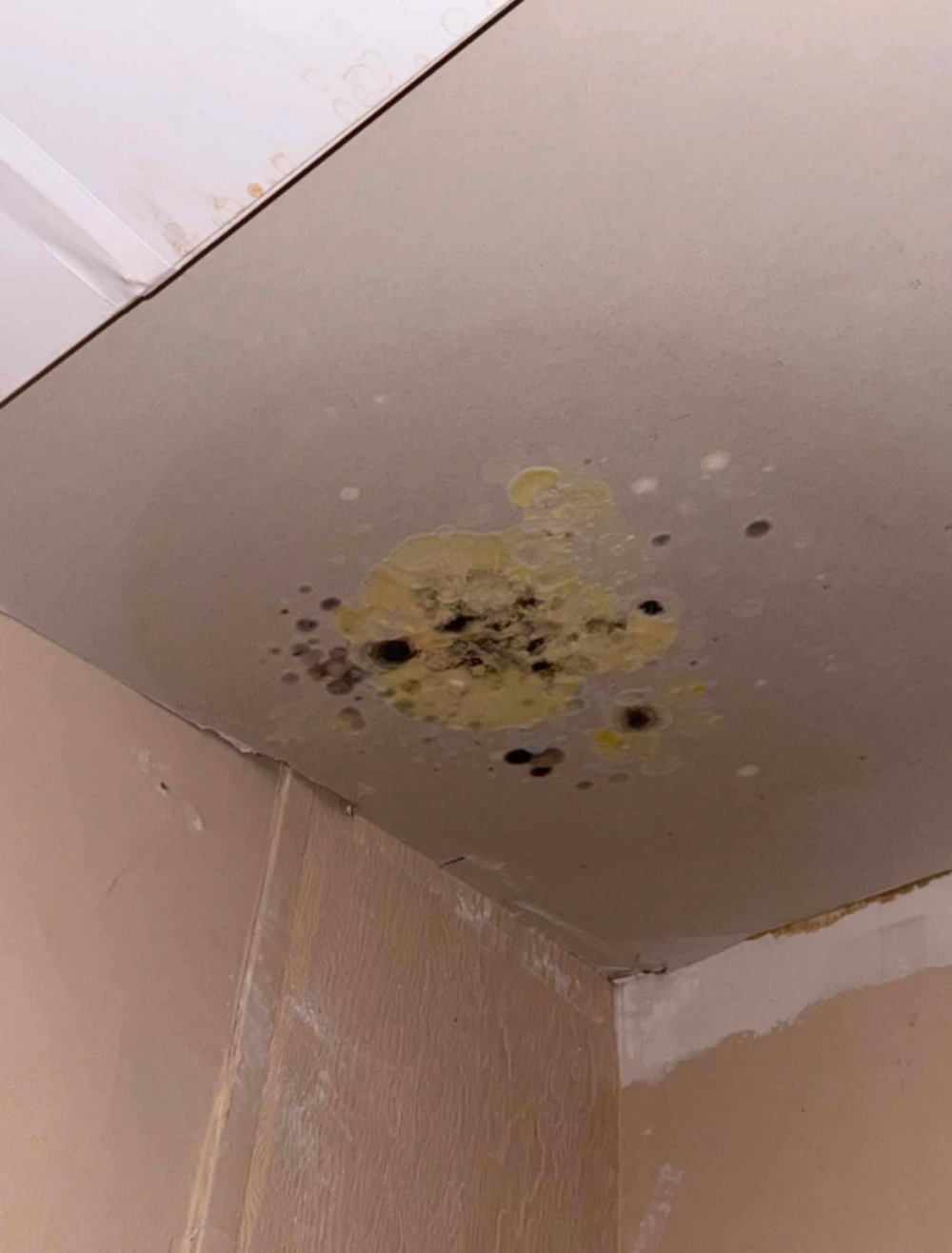
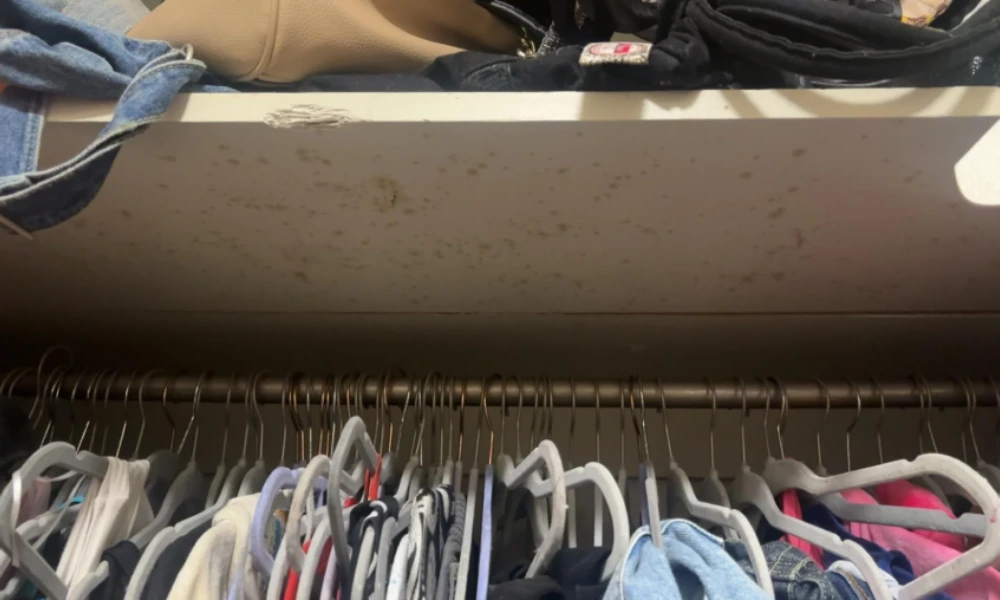
Condensation wipes away and stays gone. Mold returns within days – it’s rooted into the material, and carries a musty, earthy smell. If it keeps coming back after cleaning, treat it as mold and get it assessed.
Still not sure? Call and describe it: (917) 694-9003. We’ll tell you honestly whether it needs professional attention.
If your landlord says “it’s just condensation” – that’s not a call they should make. Under NYS law, determining what it actually is requires an independent assessor with lab testing.
🔍 Spot It Early
Signs of Mold in Your Inwood Apartment – And What Each One Means
The most common signs of mold in an Inwood apartment are a musty smell that won’t clear, spots that return after cleaning, bubbling paint, water rings on the ceiling, and constant condensation. Each one points to a different moisture source. The source decides the fix, not the spot you can see.
Musty, earthy smell that won’t go away
Usually means: Hidden moisture in a wall cavity, closet, or basement. In pre-war buildings, often a slow leak from an old supply riser.
What to do: Get it assessed. A smell with no visible mold usually means the growth is behind a surface.
Spots that come back after you wipe them
Usually means: Mold rooted in porous material like drywall, plaster, or grout, still being fed by moisture.
What to do: Stop scrubbing. The material and the water source both need attention.
Bubbling paint or soft, crumbly plaster
Usually means: Water moving through old masonry, or a leak behind the wall.
What to do: Find the water first. Repainting just hides it for a season.
Brown water rings on the ceiling
Usually means: A leak from the unit above, the roof or parapet, or a riser. Ceilings can stay damp for months after a leak stops.
What to do: Have it checked with a moisture meter, even if it looks dry.
Condensation on windows, pipes, or radiators
Usually means: High indoor humidity, windows shut all winter, uninsulated pipes.
What to do: An early warning, not always mold yet. Ventilate and keep humidity under 60%.
Coughing, stuffy nose, or worse asthma that eases when you leave
Usually means: A possible damp or mold problem affecting indoor air.
What to do: See a doctor, and get the moisture source checked.
Seeing two or more of these? Call (917) 694-9003 and describe it. If it’s something you can handle yourself, we’ll say so.
Our Mold Services in Inwood
We handle the full range of moisture and mold problems specific to Upper Manhattan’s building stock. Every job starts the same way: find the water source first.
🏠
Basement Mold Removal
The most common job in Inwood, tied to below-grade storage and laundry in pre-war walk-ups.
🌊
Water Damage & Post-Flood Mold
Burst pipes, appliance overflows and storm water. We dry it fast and document the cause, because that’s what decides whether insurance pays.
⬛
Black Mold Removal
Handled accurately, not sold on fear. “Black mold” is a color description, not a species diagnosis.
🏚️
Attic Mold Removal
Top-floor units and roof bulkheads under old flat roofs and parapets, where poor ventilation lets moisture collect all winter.
🚿
Bathroom Mold Removal
Grout, window sills, behind the tub and under the sink. If you’ve scrubbed it with bleach three times and it’s back, the water is coming from behind the wall.
🚿
Kitchen Mold Removal
Under-sink leaks, dishwasher and fridge lines, and mold inside base cabinets you usually smell before you see.
🕳️
Crawl Space Mold
Less common in Inwood’s apartment buildings, but we handle crawl spaces under storefronts, additions and older houses.
🔬
Independent Mold Testing
Done by a separate licensed assessor we coordinate for you – that’s the law. Air sampling + lab results.
⚡
Emergency / 24-Hour Response
Burst pipe, active leak, basement flooding, sewage backup. We respond fast and document for insurance.
Is bleach enough to remove mold?
No, not for most real mold problems. Bleach and vinegar can handle small patches on hard, non-porous surfaces like tile, glass, or sealed metal. They do nothing for porous materials – drywall, plaster, wood framing, insulation – because the mold has grown into the material, and the liquid only hits the surface. That’s exactly why professional quotes run into the thousands: the contaminated porous material has to come out, not just get wiped.
What kills black mold naturally?
On a small, hard, non-porous surface, white vinegar or a diluted store-bought cleaner will kill surface mold well enough. But “natural” methods don’t fix the reason it grew – the moisture – and they can’t reach mold inside drywall or wood. If the area is bigger than about a bath towel, keeps returning, or sits on a porous material, no spray solves it. The material has to be removed and the water source corrected.
⚖️ Know Before You Hire
NYC & New York State Mold Law – Explained Plainly
This is the part most mold companies skip, and it’s the part that protects you. New York has some of the strictest mold rules in the country – written specifically to stop the scare-and-upsell fraud that spread after Sandy. Knowing these rules is your best defense against overpaying.
Labor Law Article 32
Statewide since 2016
For any mold project over 10 square feet, the company that assesses the mold and the company that removes it must be separate, independently licensed businesses. The assessor writes a plan; a different licensed remediator carries it out; and an independent assessor confirms it’s clean.
New York created this split on purpose – so the company diagnosing the problem can’t profit from inflating it.
Local Law 55
Asthma-Free Housing Act – 2018
In buildings with 3+ apartments, landlords must inspect every unit for mold and pests once a year – proactively, not just when someone complains.
Mold of 10+ sq ft in a building with 10+ units triggers the full Article 32 licensed-party requirement. HPD rates mold violations by size in a room. Under 10 sq ft is Class A (90 days). The two larger classes, which need licensed work in bigger buildings:
📅 Inwood Mold Calendar
When Mold Shows Up in Inwood – Season by Season
In Inwood, mold grows fastest in summer humidity, spikes after late-summer storms, and gets reported most in fall and winter, when windows stay shut and steam heat adds condensation. Knowing the season helps you catch it early instead of after it spreads.
Spring
March – MaySnowmelt and spring rain push groundwater into lower-grade basements, and the first humid weeks wake up old damp spots.
Check: Basement walls, below-grade storage, laundry rooms
Summer
June – AugustNYC runs 65-72% humidity. The EPA flags anything above 60% as high risk, so unventilated basements and bathrooms grow mold with no leak at all. Window AC units drip and grow it inside.
Check: Basements, bathrooms, window AC units
Storm Season
August – OctoberSandy (2012) and Ida (2021) both flooded Upper Manhattan basements. Wet materials can start growing mold within 24 to 48 hours if they are not dried properly.
Check: Basements after heavy rain, sump pumps, ground-floor walls
Fall & Winter
October – FebruaryWindows stay shut, steam radiators run, and warm air condenses on cold exterior walls. October is Inwood’s peak month for mold complaints.
Check: Window sills, exterior walls, closets, behind furniture
Our Proven 7-Step Mold Removal Inwood Process
The order matters as much as the steps. Skip the moisture source and the mold comes back; skip containment and you spread spores through the apartment; skip independent clearance and you have no proof it’s actually done.
01
Consultation & moisture check
We look at the affected area, the surrounding materials, and – most importantly – where the water is coming from. Sometimes the honest answer is “this is small enough to handle yourself.” We’ll say so.
02
Independent licensed assessment
For anything over 10 square feet, a licensed assessor documents the extent and writes the remediation plan. This is the separate, independent step the law requires.
03
Written scope of work
You get it in writing before anyone starts – areas, materials, methods, and estimate. No surprises mid-job.
04
Containment
We seal the work area with polyethylene sheeting and negative air pressure so spores don’t travel to the rest of the home.
05
Removal & HEPA cleaning
Contaminated porous material comes out; hard surfaces get HEPA vacuuming and cleaning; air scrubbers run throughout.
06
Antimicrobial treatment & drying
EPA-registered treatment, then we dry the structure to a measured moisture target – not “looks dry,” but metered dry.
07
Independent clearance testing
A separate assessor verifies the work with air and surface sampling sent to an accredited lab. You get the documentation. We don’t grade our own homework.
How long does mold remediation take?
A small, contained job – a bathroom wall, an isolated closet – is often done in one to three days. Larger jobs involving a full basement, flood damage, or hidden mold across multiple rooms can run a week or more, plus drying time before clearance testing. The honest variable is the moisture source: until that’s fixed and the structure is metered dry, clearance can’t pass. We give you a timeline in the written scope, not a guess on the phone.
Do I need to leave my home during remediation?
Usually not. Most Inwood apartment jobs are contained to one room, and containment plus negative air pressure keeps the rest of the home livable. You may want to stay elsewhere if the work is large, if it involves a bedroom you use nightly, or if someone in the household has asthma or is immunocompromised. We’ll tell you honestly which situation yours is before we start – it’s part of the written scope.
💡 Why Choose Us
What Makes Us Different
Worried you’ll get scared into a five-figure job you don’t need? Here are five things we do on every job, and what they mean for you.
We Fix the Moisture Source
Most callbacks happen because someone treated the mold and ignored the leak. We treat the water source as the real job. If we can’t identify it, we tell you – we don’t pretend paint solves it.
Independent Clearance – Always
We don’t sign off on our own work. A separate licensed assessor tests the air and surfaces, and you keep the lab documentation. That’s both the law over 10 sq ft and the only version of “it’s clean” that means anything.
We Work Upper Manhattan, Not All Five Boroughs
We work Inwood and the blocks around it, not a service map stretching from Staten Island to Long Island. When we say pre-war plumbing or Sandy-legacy moisture, it’s because we see it here every week.
Calm, Not Fear-Based
Mold is a moisture problem to be solved, not a health emergency to panic you into a five-figure demolition. We give you the facts, the scope, and the real options – including the cheaper ones.
Real Documentation, Real Photos
Written scope before work, lab clearance after, and genuine before/after photos of actual Inwood jobs. Photos from actual Inwood jobs, and the paperwork to back them up if a landlord, buyer or co-op board ever asks.
❓ Who should you call for mold removal in Inwood, Manhattan?
Real Inwood Jobs – Before & After
Three real mold removal Inwood jobs – a hidden supply-line leak in a pre-war walk-up, a recurring bathroom wall near Seaman Ave, and a Dyckman-area rental. Anonymized by request. Every detail is exactly what happened.
Case Study 1
Pipe leak behind a bedroom wall · pre-war walk-up, Inwood (10034)
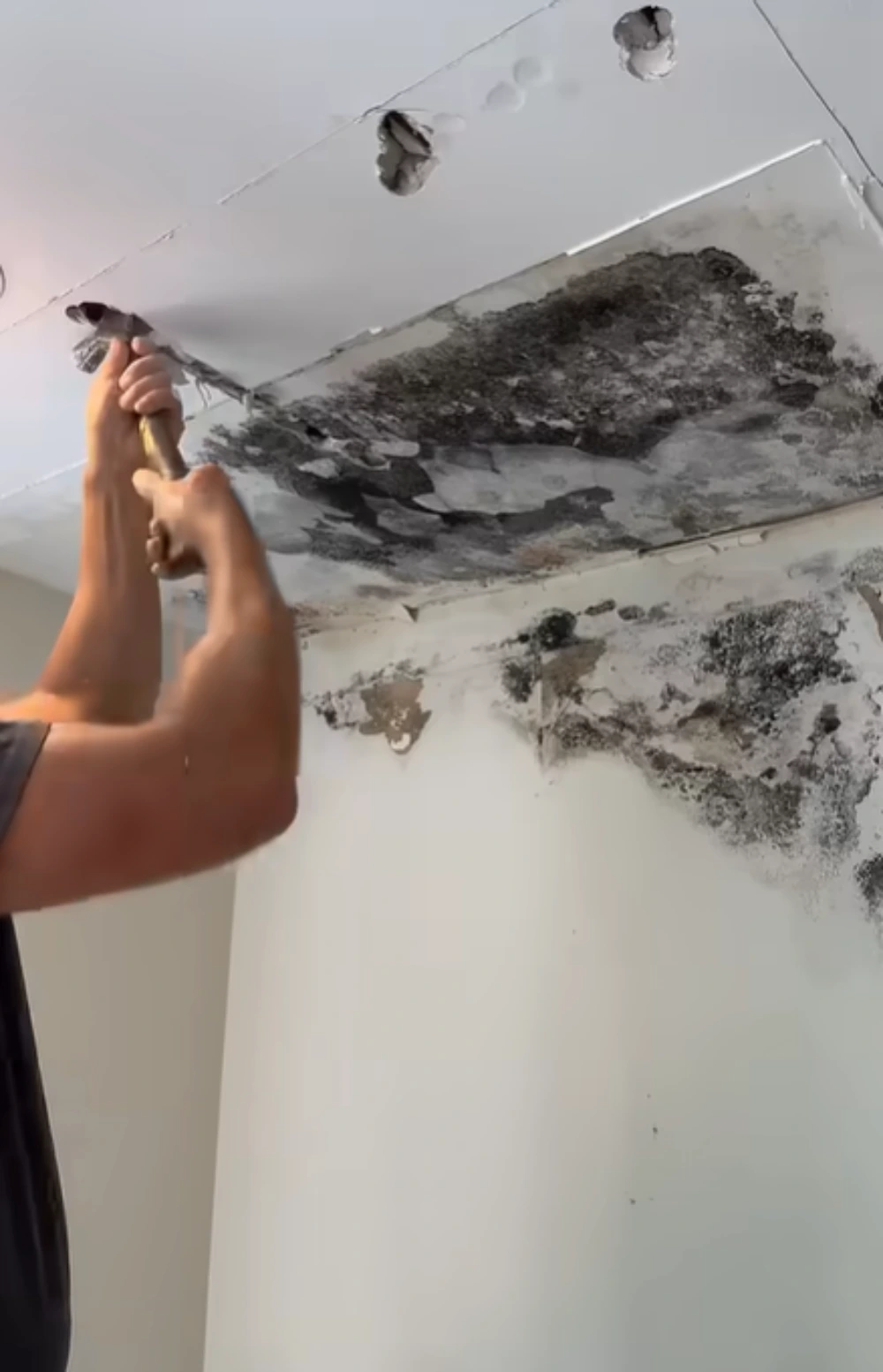
The situation: An owner noticed dark spotting spreading on a bedroom wall, weeks after a slow supply-line leak they’d assumed was minor. A musty smell had crept in with it.
What we found: The wall cavity behind the drywall was wet – the leak had been feeding it long before anything showed on the surface. Painting over it earlier would have just hidden it for a season.
What we did: Contained the room, removed the affected drywall section, HEPA-cleaned and treated the area, then dried the cavity to a metered target before closing it back up. Independent clearance confirmed it clean.
The result: Months later, nothing has come back.
Typical cost for this type of job: $800 – $2,500 for a small, contained wall section like this one, plus independent assessment ($350 – $900) and clearance testing ($300 – $600). Your exact price comes in the written scope.
Case Study 2
Recurring bathroom-wall mold · near Seaman Avenue
The situation: A resident had been wiping visible mold off the same spot for weeks. It kept returning. This is the most common DIY trap we see.
What we found: The mold was fed by a plumbing leak, and the porous wall material behind it had stayed saturated the whole time. Surface wiping never touched the actual problem – the moisture never dried out, so the mold always grew back.
What we did: Removed the affected porous material instead of cleaning around it, corrected the moisture, dried the structure, and cleared it independently.
The result: It hasn’t returned since. The lesson we point every DIYer to: if it keeps coming back, the water’s still there.
Typical cost for this type of job: $2,500 – $7,500 for a bathroom wall with porous material removal, plus independent assessment ($350 – $900) and clearance testing ($300 – $600). Your exact price comes in the written scope.
Case Study 3
Rental-unit remediation before re-rent · Dyckman area
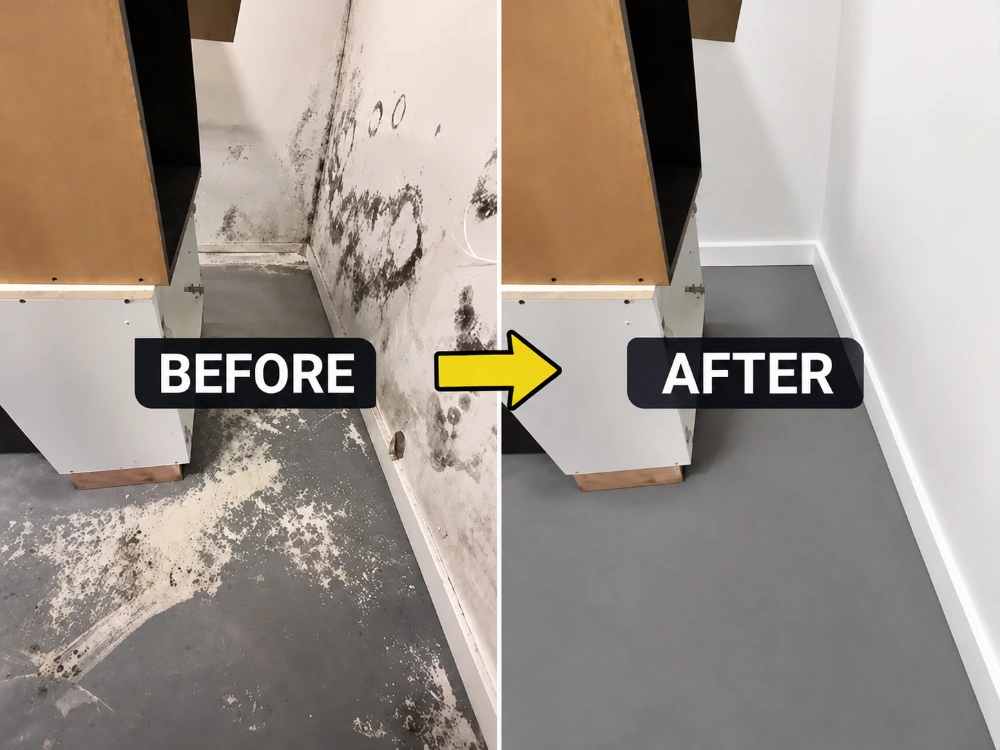
The situation: A landlord had a reported mold problem in a unit and needed it handled properly before a new tenant moved in – not papered over, with real documentation in case it was ever questioned.
What we found: A contained mold area that needed proper removal, plus a written record the owner could stand behind for Local Law 55 and any future HPD inquiry.
What we did: Full containment and removal to a written scope, moisture corrected, and independent clearance testing so there’s a lab-backed paper trail – exactly what a Certification of Correction should rest on.
The result: The unit was ready to re-rent as soon as the work was done, with documentation on file.
Typical cost for this type of job: $800 – $2,500 for a contained area in a single unit, plus independent assessment ($350 – $900) and clearance testing ($300 – $600). Your exact price comes in the written scope.
About Us – Inwood Mold & Remediation
We Work One Neighborhood. We Know It Cold.
We’re a mold remediation operation focused on one neighborhood: Inwood and the surrounding Upper Manhattan blocks – Washington Heights, Marble Hill, Dyckman, and Fort Tryon. Not all five boroughs, not “the tri-state area,” and not the other Inwood out in Nassau County. This one – 10034, between the Hudson and the Harlem River. We remediate. Assessment and clearance are done by an independent licensed assessor we coordinate for you.
That focus is the point. We know what a 1920s Inwood building is made of, how its plumbing fails, where its basements flood, and which winters bring the condensation calls. When we say pre-war walk-up or leftover Sandy moisture, it’s because we see it here every week.
The credibility here comes from the work, the documentation, the license, and real photos of real Inwood jobs. We’ll also tell you when you don’t need us – and that’s how we’ve built every referral we’ve received.
Upper Manhattan only
32 NYS licensed –
assessor & remediator separate
written scope upfront
every remediation job
Licenses & Commitments
- ✓ NYS Article 32 Licensed – Mold Remediation Contractor
- ✓ Assessment & clearance by an independent licensed assessor we coordinate
- ✓ Written scope of work before anything starts
- ✓ Third-party clearance testing on every job
- ✓ License verifiable at dol.ny.gov
- ✓ No fear-mongering – we tell you what you actually need
- ✓ Fully bilingual service – Hablamos Español
What Inwood Customers Say
Real reviews from real customers, edited only for length and clarity.
★★★★★
“We had a pipe leak that turned into mold on the wall – the kind of thing that gets worse fast if you let it sit. They came in, took out the damaged section, and actually cleaned up the mold instead of just painting over it. Wall dried out completely and everything was left clean when they finished. It’s been months now and nothing’s come back.”
James Carter – Inwood, Manhattan, NY 10034
★★★★★
“Mold showed up after a plumbing leak in our apartment near Seaman Ave. I’d already tried wiping down the visible spots myself, but it just kept coming back – turns out that’s what happens when the moisture behind it never actually dries out. They pulled the affected material, cleaned the area, and this time actually dealt with the moisture. Been fine since.”
David Thompson – Seaman Avenue area, Inwood
★★★★★
“There was a good amount of visible mold in the apartment and honestly it had me pretty stressed. They contained the area before touching anything, handled the affected spots, and cleaned up thoroughly after. No mold left where they worked, and the place was spotless when they left. Such a relief to have it actually taken care of instead of just covered up.”
Patricia Williams – Inwood, Manhattan, NY 10034
★★★★★
“Water got into our apartment on West 207th and I had a feeling mold would follow – sure enough, it did. They dried out the area, removed what had to go, and handled the mold itself. Everything looks good now, no more musty smell hanging around the room.”
Daniel Garcia – West 207th Street, Inwood
★★★★★
“Had mold reported in one of my rental units near Dyckman and needed it handled properly, not just papered over before the next tenant moved in. They came in, dealt with the affected area, and cleaned everything up the right way. Unit was ready to re-rent as soon as the work was done. Solid job, no complaints.”
Linda Johnson – Dyckman area, Inwood
📍 Service Area
Areas We Serve – Upper Manhattan Only
We work Inwood and the immediately surrounding Upper Manhattan neighborhoods – and only these. Not five boroughs, not a franchise map.
Inwood, Manhattan
ZIP 10034From the Hudson to the Harlem River – Dyckman St, Broadway, Seaman Ave, Payson Ave, Post Ave, Inwood Hill Park. Pre-war walk-ups, Art Deco co-ops, and basement apartments.
📞 Call (917) 694-9003⚖️ Know Your Rights
Know Your Rights – Tenants & Landlords
Nine out of ten Inwood residents rent, and in 2025 they filed 401 mold complaints with 311, about 3 times the Manhattan rate per apartment (Inwood mold data). The most common questions we get aren’t about quotes – they’re about rights. We built full guides for both sides.
For Tenants
- What to do if your landlord won’t fix mold
- How the 311 → HPD complaint process works, step by step
- Your rights as a rent-stabilized tenant
- Mold in NYCHA / Dyckman Houses apartments
- Where to find free or low-cost legal help (HP Action)
For Landlords & Property Managers
- Local Law 55 annual inspection requirements
- What to do after an HPD violation (Class B vs. Class C)
- Hiring an assessor and remediator correctly under Article 32
- How to file a Certification of Correction
- Protecting yourself before a problem ever starts
NYC Mold Laws Explained
- Article 32 plain-language summary
- Local Law 55 landlord duties
- HPD violation classes and cure windows
- The 311 complaint pathway
❓ Common Questions
Frequently Asked Questions
Still Not Sure You Need Mold Removal in Inwood?
Call (917) 694-9003 and describe what you’re dealing with. If the answer is “you can handle this yourself,” that’s what you’ll hear.